-
aim-resolve: Automatic Identification and Modeling for Bayesian Radio Interferometric Imaging
Fuchs, R., Knollmüller, J., Roth, J., Eberle, V., Frank, P., Enßlin, T.A., Heinrich, L.
Astronomy & Astrophysics 2026, 711, A210
-
Milky Way Atlas: A radial-velocity-resolved, three-dimensional map of H I within 1.25 kpc
McCallum, L., Söding, L., Berkner, M., Frank, P., Guardiani, M., Roth, J., Soler, J.D., Benjamin, R., Enßlin, T., Mertsch, P., Tassis, K., Pavlidou, V.
MNRAS 2026, 550, stag1303
-
DEFROST: Detecting Excess in Faraday Rotation thrOugh Sophisticated analysis Techniques
Vacca, V., Hutschenreuter, S., Cabriolu, A., Enßlin, T.A., Roth, J., Reineke, M., Frank, P., Govoni, F., Murgia, M., Fenu, G.
Astronomy & Astrophysics 2026, 710, A397
-
The radial component of the local Galactic magnetic field in 3D
McCallum, L., Frank, P., Hutschenreuter, S., Benjamin, R., Booth, R.A., Clark, S.E., Haverkorn, M., Hill, A.S., Mertsch, P., Ordog, A., Saydjari, A.K., West, J.
MNRAS, 2026
-
Bayesian multiband imaging of SN1987A in the Large Magellanic Cloud with SRG/eROSITA
Eberle, V., Guardiani, M., Westerkamp, M., Frank, P., et al.
Astronomy & Astrophysics 2026, 706, A229
-
A Bayesian method for air-shower reconstruction using Information Field Theory
Terveer, K., Bouma, S., Buitink, S., et al. incl. Frank, P.
Astroparticle Physics 2026, 179, 103241
-
The influence of the 3D Galactic gas structure on cosmic-ray transport and gamma-ray emission
Ramírez, A., Edenhofer, G., Enßlin, T.A., Frank, P., et al.
Astroparticle Physics 2026, 174, 103151
-
J-UBIK: The JAX-accelerated Universal Bayesian Imaging Kit
Eberle, V., Guardiani, M., Westerkamp, M., Frank, P., Rüstig, J., Stadler, J., Enßlin, T.A.
Journal of Open Source Software, 11(120), 7768, 2026
-
Latent-space Field Tension for Astrophysical Component Detection
Guardiani, M., Eberle, V., Westerkamp, M., Rüstig, J., Frank, P., Enßlin, T.A.
Astronomy & Astrophysics 2025, 703, A203
-
Spatially Coherent 3D Distributions of HI and CO in the Milky Way
Söding, L., Edenhofer, G., Enßlin, T.A., Frank, P., et al.
Astronomy & Astrophysics 2025, 693, A139
-
Towards a Field Based Bayesian Evidence Inference from Nested Sampling Data
Westerkamp, M., Roth, J., Frank, P., Handley, W., Enßlin, T.A.
Entropy 2024, 26(11), 930
-
fast-resolve: Fast Bayesian Radio Interferometric Imaging
Roth, J., Frank, P., Bester, H.L., Smirnov, O.M., et al.
Astronomy & Astrophysics 2024, 690, A387
-
Disentangling the Faraday rotation sky
Hutschenreuter, S., Haverkorn, M., Frank, P., et al.
Astronomy & Astrophysics 2024, 690, A314
-
Non-parametric Bayesian reconstruction of Galactic magnetic fields using Information Field Theory
Tsouros, A., Bendre, A.B., Edenhofer, G., Enßlin, T.A., Frank, P., et al.
Astronomy & Astrophysics 2024, 690, A102
-
Re-Envisioning Numerical Information Field Theory (NIFTy.re): A Library for Gaussian Processes and Variational Inference
Edenhofer, G., Frank, P., Roth, J., Leike, R.H., et al.
Journal of Open Source Software, 9(98), 6593, 2024
-
A Parsec-Scale Galactic 3D Dust Map out to 1.25 kpc from the Sun
Edenhofer, G., Zucker, C., Frank, P., Saydjari, A.K., et al.
Astronomy & Astrophysics 2024, 685, A82
-
First spatio-spectral Bayesian imaging of SN1006 in X-ray
Westerkamp, M., Eberle, V., Guardiani, M., Frank, P., et al.
Astronomy & Astrophysics 2024, 684, A155
-
Attention to Entropic Communication
Enßlin, T.A., Weidinger, C., Frank, P.
Annalen der Physik 2024, 2300334
-
Introducing LensCharm – A charming Bayesian strong lensing reconstruction framework
Rüstig, J., Guardiani, M., Roth, J., Frank, P., Enßlin, T.A.
Astronomy & Astrophysics 2024, 682, A146
-
Inferring Evidence from Nested Sampling Data via Information Field Theory
Westerkamp, M., Roth, J., Frank, P., Handley, W., Enßlin T.A.
Phys. Sci. Forum 2023, 9(1), 19
-
Multi-Component Imaging of the Fermi Gamma-ray Sky in the Spatio-spectral Domain
Platz, L.I., Knollmüller, J., Arras, P., Frank, P., et al.
Astronomy & Astrophysics 2023, 680, A2
-
Butterfly Transforms for Efficient Representation of Spatially Variant Point Spread Functions in Bayesian Imaging
Eberle, V., Frank, P., Stadler, J., Streit, S., Enßlin, T.A.
Entropy 2023, 25(4), 652
-
Dynamical field inference and supersymmetry
Westerkamp, M., Ovchinnikov, I., Frank, P., Enßlin, T.A.
Entropy 2021, 23, 1652
-
Probabilistic Autoencoder using Fisher Information
Zacherl, J., Frank, P., and Enßlin, T.A.
Entropy 2021, 23, 1640
-
Bayesian decomposition of the Galactic multi-frequency sky using probabilistic autoencoders
Milosevic, S., Frank, P., Leike, R., Müller, A., Enßlin, T.A.
Astronomy & Astrophysics 2021, 650, A100
-
Reconstructing non-repeating radio pulses with Information Field Theory
Welling, C., Frank, P., Enßlin, T.A., and Nelles, A.
JCAP 2021, 04, 071
-
Non-parametric Bayesian Causal Modeling of the SARS-CoV-2 Viral Load Distribution vs. Patient's Age
Guardiani, M., Frank, P., Kostić, A., et al.
PLoS ONE 17(10): e0275011
-
Unified radio interferometric calibration and imaging with joint uncertainty quantification
Arras, P., Frank, P., Leike, R., Westermann, R., Enßlin, T.A.
Astronomy & Astrophysics 2019, 627, A134
-
NIFTy 3 – Numerical Information Field Theory: A Python Framework for Multicomponent Signal Inference on HPC Clusters
Steininger, T., Dixit, J., Frank, P., et al.
Annalen der Physik 2019, 531, 1800290
-
Sharpening up Galactic all-sky maps with complementary data – A machine learning approach
Müller, A., Hackstein, M., Greiner, M., Frank, P., et al.
Astronomy & Astrophysics 2018, 620, A64
-
Bayesian Image Reconstruction with Spatially Variant PSFs in X-ray Astronomy
Eberle, V., Guardiani, M., Westerkamp, M., Arras, P., Frank, P., Stadler, J., Enßlin, T.A.
arXiv:2610.02062, 2026 (submitted to A&A)
-
Variational Inference Using a Differentiable Multigrid Linear Solver
Ramírez, A., Haim, P., Föger, D., Enßlin, T.A., Frank, P., Gschwandtner, P., Jüstel, D., Mertsch, P., Minh Phan, V.H., Söding, L., Zandinejad, H., Kissmann, R.
arXiv:2608.00760, 2026
-
The 3D Structure and Kinematics of the Local Disk-Halo Interface: Intermediate-velocity Clouds are the Minority of High-altitude Clouds in the Solar Neighborhood
O’Neill, T.J., Saydjari, A.K., Zucker, C., Koch, E.W., Benjamin, R.A., Frank, P., Yoshida, S.
arXiv:2605.24342, 2026
-
A Three-Dimensional Tomographic Reconstruction of the Galactic Cosmic-Ray Proton Density
Zandinejad, H., Roth, J., Minh Phan, V.H., Edenhofer, G., Frank, P., Mertsch, P., Kissmann, R., Ramírez, A., Söding, L., Enßlin, T.A.
arXiv:2605.22739, 2026
-
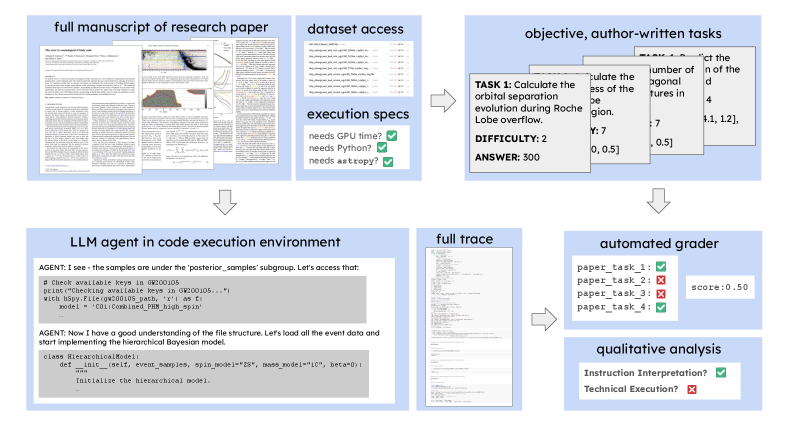
ReplicationBench: Can AI Agents Replicate Astrophysics Research Papers?
Ye, C., Yuan, S., Cooray, S., et al. incl. Frank, P.
arXiv:2510.24591, 2025
-
Information Field Theory with JAX infers Air Shower Electric Currents from Antenna Signal Traces
Straub, M., Enßlin, T.A., Erdmann, M., Frank, P., Zingler, M.
arXiv:2507.20555, 2025
-
Correlation as a Resource in Unitary Quantum Measurements
Johnson, V., Singh, A., Leike, R., Frank, P., Enßlin, T.A.
arXiv:2212.03829, 2025
-
Sparse Kernel Gaussian Processes through Iterative Charted Refinement (ICR)
Edenhofer, G., Leike, R.H., Frank, P., Enßlin, T.A.
arXiv:2206.10634, 2022
-
The Galactic 3D large-scale dust distribution via Gaussian process regression on spherical coordinates
Leike, R.H., Edenhofer, G., Knollmüller, J., Alig, C., Frank, P., Enßlin, T.A.
arXiv:2204.11715, 2022
-
Separating diffuse from point-like sources – a Bayesian approach
Knollmüller, J., Frank, P., Enßlin, T.A.
arXiv:1804.05591, 2018
-
GraphGP: Scalable Gaussian Processes with Vecchia’s Approximation
Dodge, B., Frank, P., Clark, S.E.
Conference on Physics and AI at Stanford (PAI 2026), accepted; arXiv:2606.11402, 2026
-
GAMBIT: a Bayesian framework for radio antenna beam modelling
Pashapour-Ahmadabadi, M., Schwarz, D.J., Basu, A., Eberle, V., Enßlin, T., Frank, P., Fuchs, R., Klöckner, H.-R., Nelles, A.
Proc. SPIE 14153, Radio Telescopes, Technologies, and Methods, 2026
-
Application of Bayesian Statistical Tools to SKA Telescopes Polarization Surveys to Study Magnetization of the Large-scale Structure of the Universe
Vacca, V., Hutschenreuter, S., Cabriolu, A., Enßlin, T.A., Frank, P., Roth, J., Reinecke, M., Jasche, J., Leclercq, F., et al.
Advancing Astrophysics with the SKA II (community chapter), 2026
-
Electric Field Reconstruction with Information Field Theory
Strähnz, S., Huege, T., Frank, P., Enßlin, T.A.
PoS (ARENA2024) 470, 056, 2024
-
Analysis of Dynamical Field Inference in a Supersymmetric Theory
Westerkamp, M., Ovchinnikov, I., Frank, P., Enßlin, T.A.
Phys. Sci. Forum 2022, 5(1), 27
-
Towards Moment-Constrained Causal Modeling
Guardiani, M., Frank, P., Kostić, A., Enßlin, T.A.
Phys. Sci. Forum 2022, 5(1), 7
-
Efficient Representations of Spatially Variant Point Spread Functions with Butterfly Transforms in Bayesian Imaging Algorithms
Eberle, V., Frank, P., Stadler, J., Streit, S., Enßlin, T.A.
Phys. Sci. Forum 2022, 5(1), 33